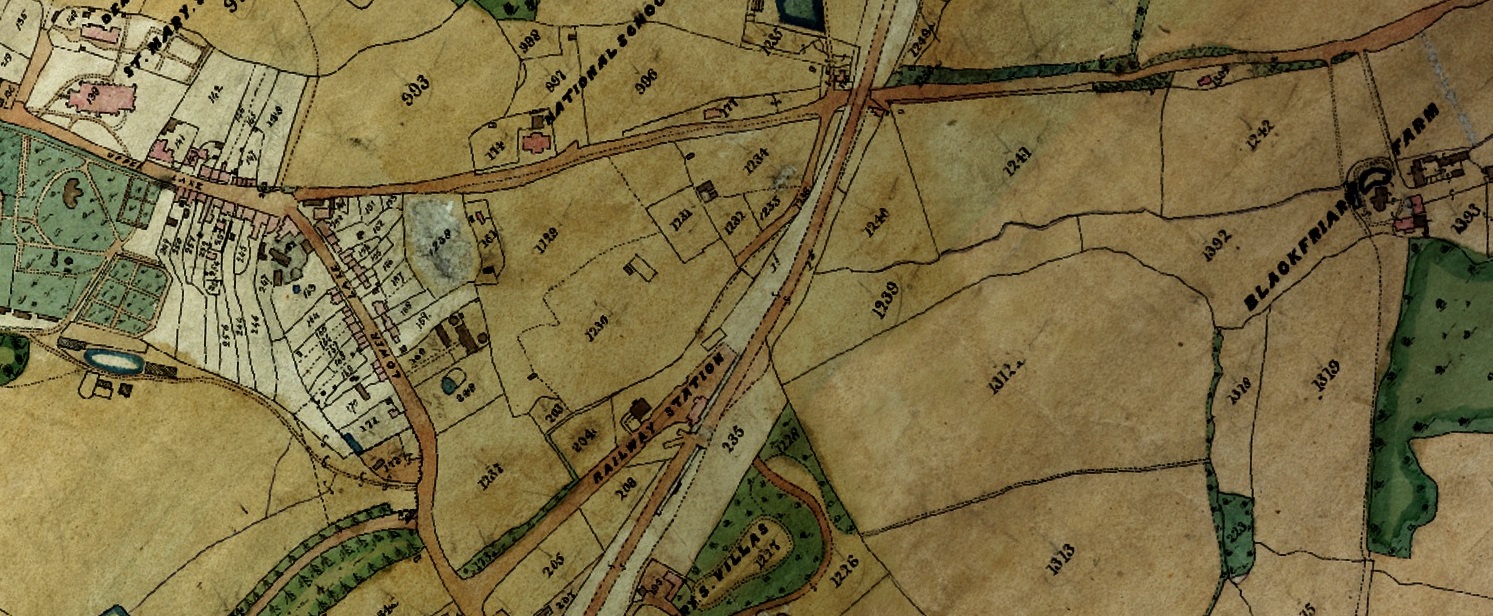
For nearly two centuries, historians and antiquarians have searched the landscape around Battle for one of the most memorable features in the story of Hastings. They have found streams, marshes, ravines, gullies and ditches. They have proposed one location after another. The mystery remains.
There is an obvious way to begin an investigation of the Malfosse.
Go to Battle.
Stand near the abbey.
Look around.
And try to find it.
According to one of the most memorable medieval accounts of the Battle of Hastings, somewhere in this landscape there was a terrible depression in the ground. It was extensive. It was concealed by vegetation. Men did not see it until they were almost upon it. Norman soldiers pursuing the English plunged into it with their horses and died in dreadful numbers.
The Chronicle of Battle Abbey describes something that sounds almost impossible to miss: a “dreadful precipice”, perhaps produced by a natural rupture in the earth or some violent action of nature, overgrown with brambles and difficult to perceive until too late.
It even gives the place a name.
Malfosse.
The bad ditch.
The evil ditch.
Yet there is a problem.
Nobody can confidently show you where it was.
That is not a modern discovery.
In 1852, the Sussex antiquarian Mark Antony Lower stood in essentially the same position as the puzzled visitor today. He knew the sources. He knew the countryside. He had translated the Chronicle of Battle Abbey. And after considering its extraordinary description, he wrote something devastatingly simple:
“There is no place near Battel which can, with a due regard to the proprieties of language, be called a ‘dreadful precipice’.”
Lower nevertheless believed the Malfosse could be located. His proposed answer would begin a search that, more than 170 years later, has still not ended.
What makes that search particularly interesting is that the problem may not simply be that the Malfosse has disappeared.
It may be that generations of investigators have been looking for the wrong thing.
A disaster that should hardly matter
The Malfosse occupies a peculiar place in the story of Hastings.
It did not decide who became king.
It did not break Harold’s army.
It did not save the English.
It does not explain William’s victory.
In the version most commonly remembered, the decisive struggle was effectively over. The English position had broken. Harold was dead or English organised resistance was collapsing. Norman troops were pursuing defeated men away from the battlefield.
And then something terrible happened.
Men who had survived the fighting began dying after victory.
Mounted pursuers encountered difficult ground without sufficient warning. Horses fell. Riders came down with them. Those following behind could not necessarily stop. Men, animals, weapons and armour accumulated in a confined space. The obstruction became worse with every new body entering it.
The event appears almost absurd in strategic terms.
Remove it from history and William still wins Hastings.
Yet medieval writers remembered it.
More strangely still, as the Battle of Hastings receded into the past, the Malfosse became more, not less, prominent.
The historian Emily A. Winkler has examined exactly this development. Her study of the episode describes the Malfosse as a “quasi-legendary” incident which, in Wace and the Chronicle of Battle Abbey, became an emotional centre of the battle. The later writers became fascinated not simply with who won or lost but with what the catastrophe must have felt like to those caught in it: ignorance, blindness, accident, helplessness and the experience of sudden death.
That may explain one of the mystery’s strangest features.
The Malfosse survived because it was horrifying.
Not because it mattered.
Before there was a Malfosse
The first important difficulty is rarely appreciated.
The earliest detailed account does not give us the famous Malfosse story in the form in which later generations inherited it.
William of Poitiers wrote within roughly a decade of Hastings. His Gesta Guillelmi contains material from which the later story appears to have developed, but the elements are distributed across separate episodes.
Near the end of the battle, he describes the English flight.
Some flee along roads; others attempt to escape through country without roads. Men lie wounded or dead. Bodies are scattered through woodland and obstruct routes. Norman horsemen pursue them, and the dead and injured suffer further beneath horses’ hooves.
Then comes another episode.
English fugitives regain confidence when difficult terrain offers an opportunity to resist. William describes a broken rampart and numerous or labyrinthine ditches. On this unfavourable ground, some important Normans are killed.
Winkler therefore describes the eventual Malfosse story as a composite of earlier episodes.
That phrase matters enormously.
Because by the time we arrive at the fully developed Malfosse legend, several things which were not necessarily a single event in the earliest narrative have begun to merge:
English flight.
Woodland.
Roads.
Pursuit.
Horses.
Bodies beneath horses.
Difficult ground.
Ditches.
A renewed English stand.
Norman deaths.
The story has ingredients before it has a name.
Orderic and the disappearing ground
Orderic Vitalis, writing in the early twelfth century, takes us closer to the event people now recognise.
In one version of his narrative, pursuing Normans encounter an old earthwork concealed beneath high vegetation. Horses and armoured riders fall together. Men arriving behind fall upon those already down. They are crushed and suffocated.
The physical mechanism suddenly becomes horrifyingly comprehensible.
The danger does not have to be an enormous canyon.
The first fall creates the conditions for the second.
The second worsens the obstacle for the third.
A relatively confined depression becomes a killing mechanism because men and horses are moving into it faster than information about the danger can travel backwards through the pursuit.
Orderic also connects the disaster with the returning confidence of the English. The difficult ground allows men who had been fleeing to turn and resist.
Later accounts differ in precisely when something like this occurred, and this chronological uncertainty would eventually become one of the great problems of Hastings historiography. One modern synthesis notes that Orderic himself preserves versions involving the concealed earthwork and the broken rampart with numerous ditches.
There is already enough here to make locating the event difficult.
Was this primarily an accident?
A last stand?
A terrain-induced Norman defeat?
Did the English cause it?
Or did they merely exploit it after it happened?
Those questions never acquired universally accepted answers.
Wace turns an accident into horror
Then comes Wace.
Writing around a century after Hastings, Wace’s Roman de Rou cannot simply be treated as an eyewitness account. But it preserves traditions about the battle that are exceptionally vivid.
His fosse episode is no dry tactical report.
Men fall.
Horses fall.
Bodies pile together.
Some men are unable to rise.
Englishmen are pulled into the catastrophe with the Normans.
And Wace gives the event an extraordinary prominence: according to the tradition he records, more Normans died there than at any other point in the day’s fighting.
Whether such a casualty statement could possibly be literal is almost beside the point.
Its significance is what it tells us about memory.
Something had grown enormously in the telling.
Winkler argues that this development is not merely medieval exaggeration for its own sake. Wace and the Battle chronicler increasingly concentrate upon the human experience of the catastrophe. Innocence and ignorance become important. Deliberate agency disappears. Men do not die because somebody successfully defeats them; they die because they do not understand what is happening until it is too late.
That is a very different kind of battle story.
And it is perhaps why the Malfosse became unforgettable.
Then the earth opens
The Chronicle of Battle Abbey gives us perhaps the most influential description of all.
Now the dangerous feature becomes something spectacular.
There is a great opening in the landscape, extensive enough to deserve extraordinary language. It is variously rendered as a precipice, chasm, pit or abyss. Vegetation conceals it. Men pursuing the English fail to perceive the danger and plunge into it.
And the chronicler attempts to explain how it came into existence.
Perhaps it was a natural fissure in the earth.
Perhaps it resulted from some violent action of the elements.
Then comes the name:
Malfosse.
The pit, the chronicler says, continued to be called that because of the disaster.
Lower’s nineteenth-century translation gave this passage enormous influence in English-language histories. His wording presents the feature as a “dreadful precipice” caused either by a “natural chasm of the earth” or some “convulsion of the elements”, concealed beneath bushes or brambles.
There is, however, something very curious buried inside the description.
The writer does not appear to know what the feature is.
He is guessing.
That distinction deserves attention.
He may know perfectly well that there was a deep and frightening depression.
He may know that it was covered by vegetation.
He may know that men failed to see it.
He may know that Normans died there.
But his explanation of how the landscape feature came into existence is explicitly uncertain.
That opens a possibility which has surprisingly large consequences.
What if the chronicler’s account contains two different kinds of information?
Observation or inherited memory: there was a deep concealed feature into which men fell.
Interpretation: perhaps nature had torn the ground open.
If so, the second part need not be true for the first to remain valuable.
And maybe, the ground simply changed in the century or so between the Battle and the writing of the Chronicle.
And that, is maybe our biggest clue.
What if “chasm” was never geology?
This is where the Malfosse mystery becomes more than a battlefield-location problem.
Imagine encountering an unusually deep cut through the landscape without understanding the process that produced it.
To a modern geomorphologist, archaeologist or road historian, some landscape features have explanations: water erosion, traffic erosion, quarrying, mining, boundary construction, road incision, repeated human use.
A medieval chronicler need not possess those categories.
He sees depth.
Steep sides.
Vegetation.
An apparently inexplicable rupture in otherwise continuous ground.
And he reaches for the explanatory language available to him.
Perhaps the earth split.
Perhaps storms hollowed it out.
That is not foolishness.
It is an attempt to explain an unfamiliar physical phenomenon.
But if later investigators treat the explanation as though it were a technical geological identification, something subtle happens.
“Men fell into a dangerous depression” becomes:
There must be an enormous natural ravine somewhere near the battlefield.
And then the search begins.
This is currently only a hypothesis about the development of the Malfosse problem. It does not prove that the Battle chronicler misunderstood the feature, still less identify what the feature really was.
But it would explain something which otherwise becomes increasingly peculiar.
For generations, intelligent investigators went looking for the Malfosse.
Again and again, they found landscapes that looked almost right.
Again and again, the answer moved.
The monks may have been investigating too
The problem becomes stranger because Malfosse was not simply a word invented by Victorian historians.
Medieval documentary evidence preserves related place-name forms.
Winkler notes early-thirteenth-century charters identifying a place called Maufosse. She also discusses Eleanor Searle’s suggestion that the monks might have encountered a mass burial feature during land reclamation and connected it with the remembered disaster.
But Winkler warns against assuming that landscape observation created the story. Wace’s vivid narrative already existed, and she suggests that his story may have influenced how the monks interpreted physical evidence rather than the landscape independently proving the literary tradition.
That is historiographically fascinating.
The interaction may already have been circular in the twelfth century.
Story influences interpretation of landscape.
Landscape then appears to confirm story.
Later chronicler records the combination.
Centuries afterwards, antiquarians use the chronicler to search the landscape again.
The Malfosse is not simply a lost physical object.
It is a piece of landscape filtered repeatedly through human memory.
1852: Mark Antony Lower goes looking
By the nineteenth century, the Battle of Hastings had become a major antiquarian problem.
And Mark Antony Lower was extraordinarily well placed to investigate it.
He was a Sussex antiquary. He knew the region. He had translated the Chronicle of Battle Abbey. In July 1852 he read a paper on the battle at Battle Abbey itself.
The opening of that paper is remarkably modern.
Lower warns that battle narratives are difficult because individuals see only fragments; insignificant events may become magnified while important ones disappear; writers have biases; rhetoric intrudes; later chroniclers inherit oral traditions.
Then he reaches the Malfosse.
He quotes the great terrifying description.
And then admits the physical problem:
there simply isn’t anything near Battle which properly deserves to be called a “dreadful precipice”.
This ought to be one of the most famous sentences in the history of Hastings research.
Because Lower had encountered the same problem that continues to bother people now.
Where is it?
Lower did not conclude that the Chronicle was wrong.
Instead, he reconstructed movement.
He reasoned that English flight and Norman pursuit probably moved north-west through the Mountjoy area. He associated the Malfosse with a stream running below the rising ground toward Caldbec and Whatlington. The surrounding land, he argued, could once have been marshy, overgrown with reeds and bog vegetation.
Modern drainage, in his reconstruction, had effectively removed the feature’s dangerous character.
The dreadful Malfosse had disappeared because human beings had improved the land.
Lower also brought documentary place-name evidence into the argument. He connected Malfosse with later Manfosse and with Winchester Croft, using a 1279 charter to reinforce his proposed geography.
For a time, he had an answer.
But almost immediately another one appeared.
The first rival Malfosse
Lower’s additional notes reveal something wonderfully familiar.
Before his paper was even completely finished, he learned of another opinion.
Someone suggested that the catastrophe occurred on the precipitous slope and dell behind Beauport. Human bones had reportedly been discovered in swampy ground there.
It looked right.
There was dramatic terrain.
There were bones.
What more might an antiquarian want?
Lower rejected it.
Beauport was approximately three miles from Harold’s position in his reconstruction. He considered that too far away. His documentary Manfosse evidence, he believed, was stronger.
And there, almost at the beginning of the modern investigation, the pattern appears.
One investigator says:
the documents put it here.
Another says:
but look at this landscape feature.
That argument has never really stopped.
Lower’s answer spreads
Lower’s interpretation did not remain buried in a Sussex archaeological paper.
John Collingwood Bruce incorporated it into The Bayeux Tapestry Elucidated.
Bruce repeated Lower’s central observation that there was no plausible “dreadful precipice” immediately around Battle and adopted his proposed north-western identification. Lower, Bruce wrote, enabled the scene described by the sources to be associated with an actual locality.
An hypothesis was becoming inherited historical geography.
This is an important stage in the life of battlefield reconstructions.
An investigator proposes something.
A second respected writer repeats it.
A third cites the second.
Eventually readers encounter a place on a map rather than the chain of reasoning which originally put it there.
The distinction between source and solution begins to fade.
Freeman constructs the battlefield
No nineteenth-century historian shaped the modern Battle of Hastings more powerfully than Edward Augustus Freeman.
His enormous History of the Norman Conquest attempted something extraordinarily ambitious: reconcile the chronicles, the Bayeux Tapestry and the physical landscape into a coherent sequence of military events.
Freeman did not merely narrate Hastings.
He mapped it.
His 1869 volume explicitly thanked military survey work undertaken to provide an accurate ground plan of the battlefield.
And the Malfosse was incorporated into the system.
Freeman placed a final disaster after Harold’s death. English light troops flee as darkness approaches; Normans pursue; the ground north of the hill becomes steep, irregular and marshy; horses and men come to grief; fugitives exploit the pursuers’ difficulty and attack them.
Freeman considered the episode so memorable that he believed no scene had impressed itself more strongly upon later Norman memory.
But Freeman had another problem.
Some sources appeared to place a fosse disaster much earlier.
His solution was to propose two separate incidents.
One belonged to fighting earlier in the day.
The other was the post-collapse Malfosse.
This allowed contradictory accounts to become parts of a single coherent reconstruction.
It was ingenious.
But it was also precisely the kind of historical synthesis that would soon provoke one of Freeman’s fiercest critics.
Round refuses to make the sources agree
J. Horace Round attacked Freeman’s Hastings reconstruction in a celebrated article subsequently incorporated into Feudal England.
His treatment of the “fosse disaster” is particularly revealing.
Round did not pretend the evidence was straightforward.
Quite the opposite.
He called the chronology of the fosse episode “perhaps the most difficult problem” arising from the battle — one which would be safer simply to pass over.
Then he counted the disagreement.
Five authorities, as he read them, placed the disaster amid the battle.
Three assigned something similar to the pursuit of the defeated English.
Freeman resolved this by having two incidents.
Round did not say two incidents were impossible. In fact, he expressly refused to claim that Freeman must be wrong.
His point was methodological.
The evidence did not compel Freeman’s solution.
Round went further and accused Freeman of creating a “western ravine” scene not actually supplied by the authorities in the form Freeman presented it.
That dispute is enormously important for the history of the Malfosse.
Because by the end of the nineteenth century the mystery was no longer merely:
Where was the ditch?
It had become:
How many ditch incidents were there?
And:
Which sources are even describing the same event?
The physical search was being conducted before the textual problem had been solved.
Perhaps it never could be.
The Malfosse keeps moving
The twentieth century did not settle matters.
It generated more candidates.
F. H. Baring published “The Malfosse at the Battle of Hastings” in The English Historical Review in January 1907.
Six years later, W. H. Stevenson returned to the subject in the same journal with “Senlac and the Malfossé.”
The titles themselves tell the story.
Forty, fifty and sixty years after Lower, professional and antiquarian historians were still trying to determine what this thing was and where it belonged.
Different investigators associated it with different pieces of ground. Later summaries of the debate record proposals involving the Beech or Reder Stream area, Lake Field or Little Park Farm, George Meadow and Manser’s Shaw. The details and arguments varied, but the pattern remained the same: a textual description was carried into the countryside and compared against some promising physical feature.
Then, in 1963, C. T. Chevallier published an article in the Sussex Archaeological Collections with perhaps the most revealing title of all:
“Where was Malfosse? The End of the Battle of Hastings.”
Nearly eleven hundred years after the battle, and more than a century after Lower’s investigation, the question still needed asking.
Chevallier’s work became associated with Oakwood Gill, north of Caldbec Hill: a substantial gully with steep ground, vegetation and woodland nearby. Later authors found it a persuasive match for the chronicle descriptions, and the identification gained considerable influence.
At last, perhaps, the terrible ditch had been found.
Except that it had not.
Not in any conclusive sense.
The official answer: we don’t know
In 1995, English Heritage prepared its official battlefield report for Hastings.
It defined the registered battlefield.
It discussed the principal terrain.
It established boundaries around the recognised battle landscape.
And then it did something remarkably important.
It left the Malfosse out.
Why?
Because:
“the differing interpretations of this location cannot be assessed with the currently available evidence.”
That sentence is still one of the clearest statements of the state of the problem.
More than a century after Lower.
After Freeman.
After Round.
After Baring.
After Stevenson.
After Chevallier.
After generations of historians and local antiquarians had walked the countryside.
The Malfosse was still not securely located.
Why the Malfosse attracts alternative battlefields
The mystery has had another consequence.
It does not merely produce proposed Malfosses.
It can produce proposed battlefields.
If someone accepts that the sources describe a spectacular and geographically distinctive feature, then the reasoning is understandable.
The traditional battlefield does not appear to contain it.
Therefore something must be wrong.
Search farther away.
Find an impressive ravine, mining pit, deep gully, marsh or ditch.
Now the alternative landscape possesses something the conventional battlefield apparently lacks.
And the new feature begins pulling the rest of the battle toward it.
Modern alternative-location projects illustrate this repeatedly. Sedlescombe/Hurst Lane theories, for example, identify large mining features and ditches as evidence for a radically different battle landscape and explicitly use the Malfosse problem in their argument. Other interpretations place the event elsewhere.
The point is not that these theories are therefore wrong.
Nor that the traditional battlefield must therefore be right.
It is something more methodological.
The Malfosse has become a geographical attractor.
Find the right-looking ditch and the battle can start moving toward it.
That is a dangerous amount of explanatory power to give a feature whose description is itself uncertain.
Perhaps the landscape has been answering the wrong question
Which brings us back to the Battle chronicler.
For generations the influential image has been the great hidden chasm.
A dreadful precipice.
A rupture in the earth.
A feature dramatic enough to kill enormous numbers of men and horses.
Naturally, people have looked for dramatic terrain.
Lower did.
His contemporaries did.
Freeman did.
Later antiquarians did.
Chevallier did.
Modern battlefield revisionists still do.
But what if the extraordinary part of the Malfosse was not the landscape feature?
What if the extraordinary part was what happened when mounted men encountered it?
That changes everything.
A ditch does not have to be enormous to kill a horse at speed.
A steep-sided incision need not look dramatic from a distance.
Indeed, if vegetation obscures its lip, its danger may depend precisely upon how ordinary the surface appears until the last few metres.
A feature that a pedestrian could cross carefully without difficulty could become catastrophic to closely following horses.
The first animal falls.
The second has nowhere to go.
The third cannot see why the first two disappeared.
Bodies and horses progressively fill the depression.
The scale of the catastrophe is then produced partly by movement and congestion, rather than purely by the dimensions of the hole.
That possibility does not locate the Malfosse.
In one respect, it makes the mystery worse.
If we stop searching for an enormous natural ravine, we lose the feature that seemed most capable of giving us a unique geographical fix.
The candidate class becomes much broader.
An old ditch.
An incised route.
A hollow way.
An earthwork.
A sunken track.
A relatively modest ravine.
A feature altered or filled by later land use.
Now there may be dozens of possibilities.
The “dreadful precipice” at least seemed identifiable.
The real thing, if the description has misled us, may not be.
The most important question may not be “where?”
That leads to a strange conclusion.
Perhaps the Malfosse mystery has been approached in the wrong order.
For generations the question has been:
Where was the Malfosse?
But before that can safely be answered, another question may have to come first:
What was the Malfosse?
Those are not the same investigation.
If the Battle chronicler’s geological speculation is mistaken, then finding something which visually resembles his imagined explanation proves very little.
Instead, a candidate should satisfy the things the traditions actually require.
It must work within the movement of the battle.
It must be reachable during whatever phase of retreat or pursuit the relevant account describes.
It must be capable of surprising men approaching from the appropriate direction.
It must permit the physical mechanism of mounted falls, congestion and crushing.
Its relationship with roads, woodland and escape routes matters.
Its age matters.
And crucially, the battle should lead us to the feature.
The feature should not be allowed to invent the battle around itself.
That is a much harder standard.
But it may finally break the cycle which has moved the Malfosse around the Sussex landscape for almost two centuries.
There is another reason to be cautious
The medieval writers themselves may already have been doing something similar to the modern investigators.
Winkler’s research is particularly valuable here.
She argues that by Wace’s and the Battle chronicler’s time, the Malfosse had become an emotional reconstruction built from earlier narrative fragments. Wace’s account may in turn have influenced the monks’ interpretation of the landscape.
In other words, there may never have been a simple chain:
battle → eyewitness description → physical place-name → faithful chronicle.
Instead there may have been something messier:
battle → memory → different accounts → retelling → landscape interpretation → local tradition → later chronicle.
And then centuries later:
later chronicle → antiquarian search → candidate landscape → historical reconstruction.
That does not make the Malfosse fictional.
It means the historical object has been refracted through memory.
There is still a persistent core.
Something terrible happened involving difficult ground during one of the chaotic phases around the collapse and pursuit.
Men and horses died.
The incident was remembered.
But the great geological landmark people expect to find may belong partly to the history of the story, not necessarily to the history of the ground.
Why nobody gave up
There is something strangely moving about the history of this problem.
Lower died without settling it.
Freeman died without settling it.
Round died without settling it.
Baring and Stevenson did not settle it.
Chevallier did not settle it.
Generations of local historians, battlefield enthusiasts and professional scholars have gone into the Battle countryside with maps, chronicles and theories.
Many must have believed they were close.
Some believed they had solved it.
Yet the official battlefield assessment could still say, in 1995, that the competing locations could not be evaluated conclusively.
And people are still looking.
There is a reason.
The Malfosse promises something unusually seductive to anyone trying to reconstruct Hastings.
It appears to offer a fixed point.
Find Harold’s exact position and people will argue.
Find William’s line of approach and people will argue.
Reconstruct the shield wall and people will argue.
But find the great physical hole that swallowed Norman cavalry?
Surely that would be different.
Surely the landscape itself would finally speak.
That promise has kept the mystery alive.
But what if there never was a dreadful precipice?
Not that nothing happened.
Not that Wace invented everything.
Not that the Battle chronicler lied.
Something much more interesting.
What if the chronicler inherited the memory of an extraordinary accident and attempted to explain an ordinary but unfamiliar landscape feature?
What if his description of the danger was substantially right while his explanation of the landscape was wrong?
Then Mark Antony Lower’s observation in 1852 takes on an entirely different importance.
He looked around Battle and said, essentially:
There is no dreadful precipice here.
For more than 170 years, investigators have treated that as a problem requiring a missing precipice.
Perhaps it was actually a clue.
Perhaps there was never one to find.
And if so, the long failure of intelligent people to locate the Malfosse ceases to be surprising.
They were not necessarily bad investigators.
They may simply have inherited the wrong search image.
Which unfortunately leaves us exactly where we began
There is a wonderfully irritating consequence.
Suppose all of this is correct.
Suppose the “chasm” really is rhetorical or explanatory.
Suppose the physical feature was considerably more modest.
Suppose the horror came from speed, horses, concealment and congestion rather than from some enormous geological abyss.
Excellent.
We have explained why nobody could find the dreadful precipice.
There was no dreadful precipice.
But now comes the obvious problem.
Where was the damned thing?
We still do not know.
We have not solved the Malfosse.
We have merely changed what we are searching for.
And that may be the point at which the investigation finally becomes interesting again.
Because perhaps the next Malfosse should not be discovered by wandering Sussex looking for the most impressive ravine.
Perhaps it should emerge from somewhere else entirely.
From the sources.
From the movement.
From the roads.
From woodland.
From the direction of flight.
From the behaviour of pursuing cavalry.
From the history of the landscape.
And only then from the ground itself.
The Malfosse may yet be found.
But before we find it, we may have to stop looking for the thing the legend taught us to see.